April 12, 2010

the village

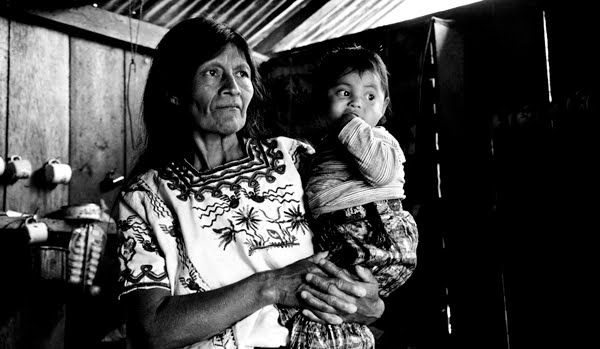
Her hands smoothly spread the corn masa into the big leaves, preparing the traditional boxbole.  Her aunt stirred the coffee beans that roasted on the iron grate above the fire.  As a younger member of the communal bank, her ideas came quietly, but they were strong.  The pigs and chickens that she had bought with her loan were clearly a source of pride.  We spent an hour on little wooden chairs in her kitchen, but the whole time my questions and Steven’s camera didn’t pause her work.

“Why are you coming here to talk to us?” one woman asked.  “Well,” I said, “I think because many of the women here don’t speak Spanish, sometimes the men speak more, and Agros doesn’t get to hear your ideas.  I think it is important to know what you think about the projects and your lives here, so I’ve come to talk with you.”  My guess at the lack of voice for women here must have resonated, because with this vision Catarina, a community leader and our translator into Ixil, became my emissary, just as passionate about this project as I was.  She guided us from house to house, explaining at each doorway that we had come to do interviews and may we have a few minutes to sit with them?  She shared this idea with each woman, and they nodded in agreement. 

We had arrived in the village a few days before.  After eight weeks of preparations - visiting villages, adjusting my project design, and preparing interviews – Steven and I were dropped off in this Ixil community a few hours from Nebaj along a rutted dirt road that hugs the side of a narrow gorge.  We knew very little about how anything would happen once we arrived, but over the next few hours, guided by a community leader, a woman was found to be our translator from Spanish to Ixil, a family agreed to feed us meals, and we pushed together the exam tables in the clinic to make a bed where we would spend the next few nights.  The next morning we ate beans and eggs and tortilla with the family, and started towards the house of the president of the Women’s Communal Bank, the first interview where I would ask about the bank, women's leadership, land ownership, and family relationships.  All with the hope to understand how these are seen from their own eyes...

We left each house full – of the words that gradually created a clearer picture of the life of the women, of bananas or atol or lime juice people warmly offered, and images of the beautiful mundane that makes up daily existence in this village.  Mostly we are grateful – that this community was willing to let us into their homes, shared their stories with us, and told us we too were just children of God like them.  Though our time was brief, we got a glimpse of living – families laughing, meals prepared, a days work – though so different in form, the very same substance of human existence lived the world over. 


April 10, 2010

semana santa

In Guatemala, Semana Santa - Holy Week - is a big event.  The whole country stops for a few days while rich people escape Guatemala City, the faithful Catholics organize processions, and everyone from rich to poor gathers with family.  We decided to taste it all...

The Cayes of Belize, off the coast of Guatemala.  Under that water were lots of fish and coral, which we flipped around with snorkels exploring for two days.  Pure joy!  Sun and color and swimming.  And for dinner, the fried fish our boat captain caught by hand line...


Waiting on this strip of sand for the tropical storm coming our way.  Shared a bunk in a bungalow with the most hospitable Italian family for the night after the drenching rains and wind knocked our tent right over.


Frigate birds turn our eyes skyward where the Rio Dulce meets the Caribbean Sea...elusive grace.  The abundance of water, jungle, and sun slows life on this side of Guatemala...from the easy-going Garifuna town of Livingston to the quiet Mayan villages hugging the riverbank...all except the enormous vacations homes and their yacht-driving owners.

Two days kayaking the gorge of Rio Dulce - trying to get close to the flighty egrets, twisting back into the jungle on an eerily still river with birds and wind making our presence seem very small, waving to the fishermen in their wooden dugout cayucos, and feasting at the lodge at the of the day.  Perhaps the truest jungle moment came when we found a hand-sized tarantula in the bathroom one night, seeking shelter from the tropical rain...

Wandering the streets of Antigua to see the art each family makes in the streets, preparing the ground for the processions that will weave their way through the city from 6pm until 4am, carrying the Virgin and Christ on a pilgrimage.  Never before had we seen such a tranquil and joyful gathering of so many Guatemalans...something between a carnival and a deeply religious gathering.


Creating beauty, the whole family, that will stand for a few hours before the night comes.  The streets are filled with families, warmth, shared joy...the generous sharing of ephemeral beauty.

Steven has more photos of Guatemala on his website...www.stevengnamphotography.com...

March 26, 2010

Small things.

Today the second-grader we live with braided my hair.  It wasn’t until then that I realized how much I missed being touched – being new here, there aren’t the hugs and closeness I’m used to at home among family and friends.  Having this seven year old chat my ears off about Christmas and New Years and her family traditions as she combed and braided up my hair, I felt at home and safe in a way I had not yet experienced here.

We cooked our first meal with garlic tonight.  The smell of it was heavenly.  Hadn’t been able to find it in the market until yesterday, when the candle-man had some braids tucked among the paraffin.  Delicious…

My shower was hot.  Really hot.  And since it is usually not quite warm enough, I endured some scalding for the pure joy of it.  Never know what you’ll get.
A good evening in Guatemala…


March 23, 2010

a meeting

Doña Maria invited us to eat lunch with her, in her family kitchen. Hot potato and corn stew, scooped from our bowls by tamalitos- so hot it made my face sweat and Steven loved it. Then we followed her into the rest of her home, where the wooden-plank beds and a bench were at once bedroom and sitting room. Her house is one of the most cared-for we’ve seen, cinderblock with a real cement floor, and pictures from a calendar thoughtfully stuck up on the wall. Through the window into the kitchen, Maria shooed the chicken from the bowl of corn.

We borrowed the room for our meeting, and more than a dozen women gathered around. I began again the same introduction I had been using for the last week, that we were volunteers here, and I was coming to talk to women to see how Agros projects were affecting them and how they might support them more. Steven was hoping to take some photos of their projects. And then my questions began – Why do they join the communal banks? Have they ever owned land before Agros came? What do they hope for their children? Each answer is something so basic to their daily life, you can sense they are not accustomed to having to explain. Yet at the end, a moment of magic. I ask them if my questions are strange, and they tell me that they like it, they are glad to be reminded of what they want for their children, education and to be able to have work.

And then, before we left, we took a walk to see the work these women were doing to bring income into the home, some with the help of an Agros micro-loan and others on their own. Outside of the meeting, showing us the work of their hands, their capacity and beauty and pride came out…but just look below and you’ll see. As usual, Steven’s work is better than words…


March 18, 2010

one month in guatemala...

eggs, beans, and tortillas
spanish grammar, ixil words
mango season
roosters
communal banks and weaving projects
flowing lava
the snow pea harvest
interviews and transcribing them
chicken buses and microbuses


March 14, 2010

Coffee and Volcanoes


 Shade grown coffee
Coffee Flowers
Coffee Berries
Women tending drying coffee
coffee drying
 Smoke Ring, Vol Pacaya

March 4, 2010

Kitchen

Shafts of light filter between the wooden planks that make up the walls of this square room.  We come in to warm our tortillas on her fire, to gather some heat away from the rain outside.  We crouch on low stools near the blaze on her earthen floor.  While we sit in silence, the cat and chickens and children, the pat, pat, pat as she hand makes tortillas from her corn masa (dough) seem a part of the quiet.  She turns the tortillas on her iron cooking slab over the fire, adds an egg to small pan on the slab that serves as her stove, pours the coffee from a scalding earthen pot  - all with her bare hand, accustomed to the heat.  Through the slats in the walls the children’s eyes stare inquisitively – as soon as I look they run away.  They tell us the children are afraid because they think we have come to vaccinate them.  She serves the beans and eggs and tortillas, throws some maize to the chickens, and feeds the baby on her breast in the corner.

The next day, another kitchen, another fire.  The family this time, gathered around.  We ask for a photo, the parents are glad and you can see their pride as they gather their children around them.  They show us pacaya, and how to eat it.  They laugh with us at our ignorance.

We tread lightly, entering into the intimate place – kitchen, hearth.  Invited, but still strangers.  We leave hushed, hardly believing where we have been.  Only because we come with the community organizer from Agros.

Later we talk with the women in the schoolhouse.  We talk of their challenges, their committee, take a tour of their projects.  But it was the kitchen where we could share with them.  We are hopeful to spend time in one or two communities as our project goes forward, to share more meals in the kitchen.